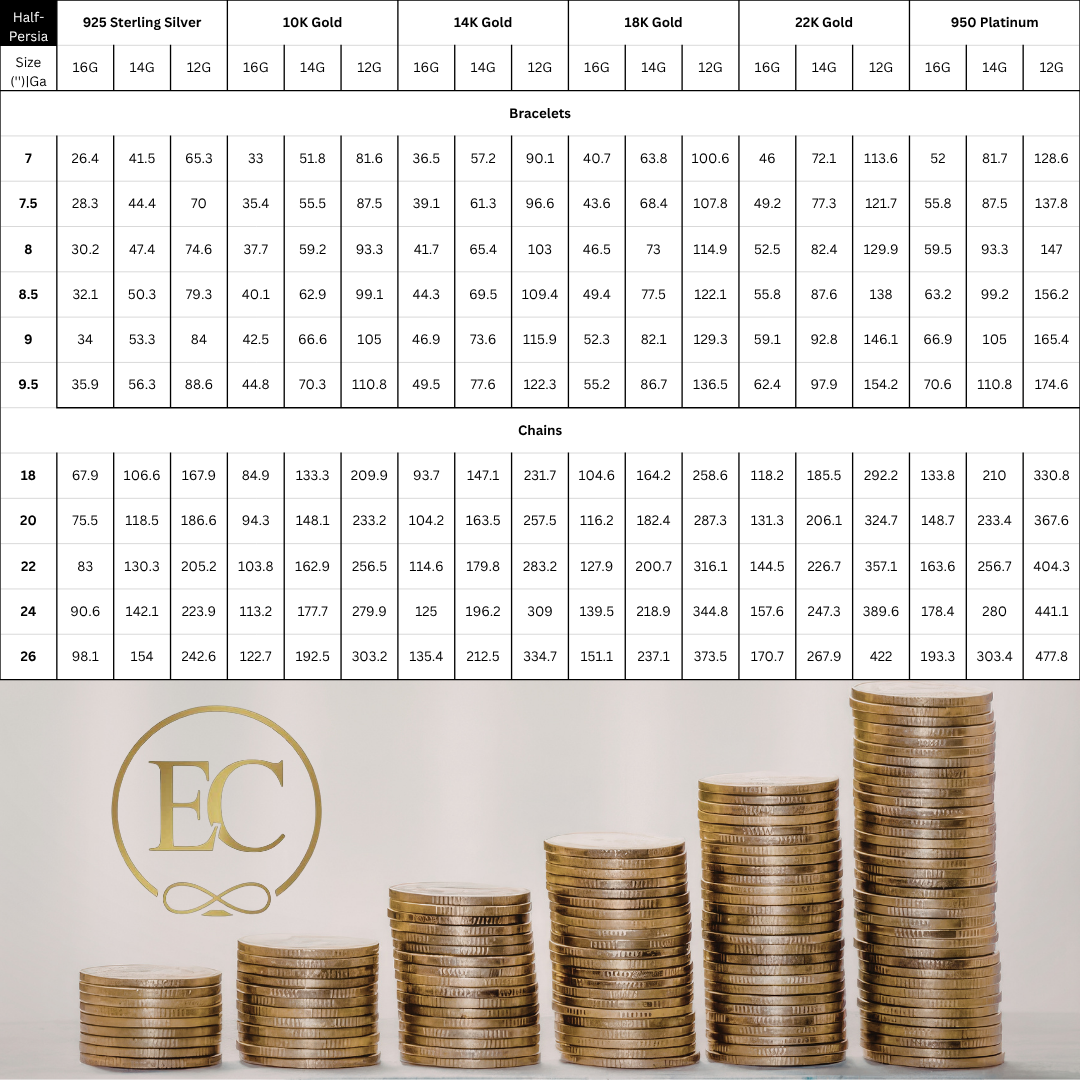
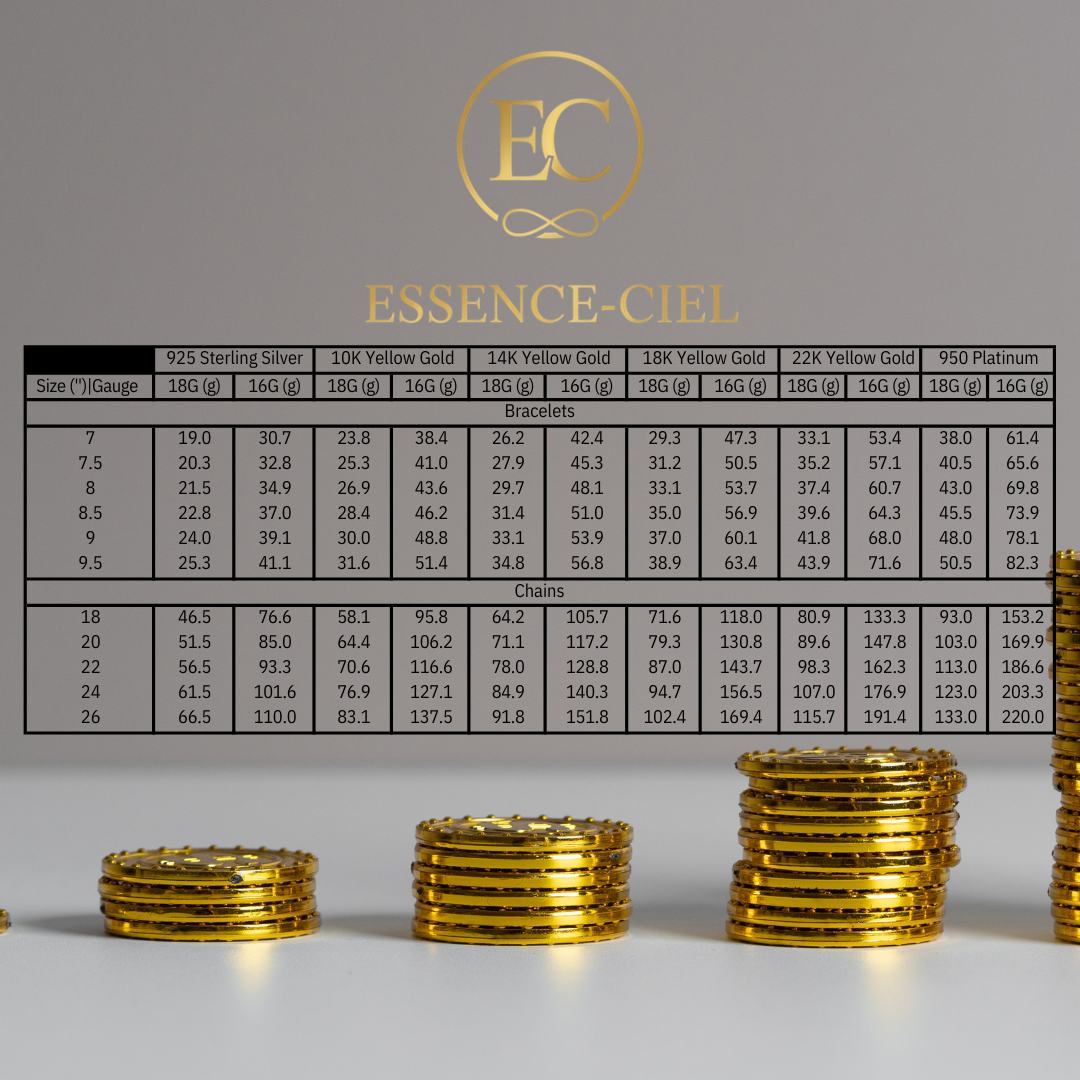
Quel devrait être le poids d'une véritable chaîne byzantine ?
Partager
1. Introduction
2. Pourquoi le poids est important pour les chaînes byzantines
- La chaîne est si solide et rassurante au toucher.
- La façon dont il se drape et bouge sur le cou
- Sa résistance à l'usure au fil des années
- Son prix est calculé en fonction de sa teneur en métaux.
3. Quels sont les facteurs qui influencent le poids d'une chaîne byzantine ?
Type de métal
- Le platine est plus dense que l'or.
- L'or est plus dense que l'argent
Longueur
Épaisseur / calibre
- De légères augmentations du diamètre du fil et de la taille des maillons peuvent ajouter beaucoup de métal à la structure.
- Une chaîne byzantine « moyenne » et une chaîne « lourde » de même longueur peuvent donner l'impression d'être des objets complètement différents en main.
construction creuse vs construction pleine
- Elles peuvent paraître grandes, mais elles sont étonnamment légères.
- Ils sont souvent plus vulnérables aux bosses et aux déformations.
4. Signes indiquant qu'une chaîne est trop légère pour sa taille
- Elle paraît épaisse et imposante sur les photos, mais elle est presque sans poids en main.
- Les maillons semblent fins ou fragiles lorsqu'on les presse entre les doigts.
- La chaîne s'affaisse sur elle-même au lieu de se comporter comme un tube dense et flexible.
5. Comment les acheteurs sérieux perçoivent le poids par rapport au confort
- Un poids suffisant pour une sensation de solidité, d'authenticité et de satisfaction.
- Pas tellement lourd que la chaîne devienne fatigante à porter toute une journée.
- La force de votre cou et de vos épaules
- À quelle fréquence porterez-vous la chaîne
- Que vous préfériez une sensation de « quasi-absence » ou un rappel constant de la présence de la chaîne, il y en a pour tous les goûts.
6. Pourquoi documentons-nous le poids de chaque pièce byzantine ?
- Chaque chaîne et chaque bracelet est pesé sur une balance de précision après sa fabrication.
- Le poids exact, la longueur, l'épaisseur et le métal sont enregistrés.
- Ces informations sont fournies au client avec la pièce.
- Vous savez exactement quelle quantité de métal vous portez.
- Cela aide à assurance et revente si nécessaire.
- Cela confirme que la chaîne est fabriquée selon des normes rigoureuses, et pas seulement pour faire bonne figure sur les photos.
7. Comment choisir la plage de poids qui vous convient le mieux
- Gamme plus légère – Pour les clientes qui recherchent un style byzantin mais préfèrent une chaîne plus discrète et facile à porter. Convient aux petites morphologies ou aux personnes sensibles au poids sur le cou.
- moyenne gamme – Le compromis idéal pour la plupart des acheteurs exigeants. La chaîne est indéniablement robuste tout en restant confortable même après une longue journée.
- Gamme lourde – Pour les clientes qui recherchent une pièce forte et qui aiment sentir la chaîne en permanence. Idéal pour les grandes montures ou pour un port occasionnel.
- Demandez-vous ce que vous avez porté auparavant et ce que vous avez ressenti.
- Je vous montrerai des exemples ou des poids de référence.
- Nous vous recommandons une gamme de prix qui corresponde à vos attentes et à votre réalité quotidienne.
8. Conclusion
Le poids est l'un des indicateurs les plus clairs de la qualité d'une chaîne byzantine. Il reflète le métal, la fabrication et l'intention qui a présidé à sa création. Une chaîne d'apparence imposante mais d'apparence légère ne procurera jamais la même sensation qu'une chaîne au poids maîtrisé et authentique.
Si vous envisagez l'achat d'une chaîne byzantine et souhaitez discuter en détail du poids, des dimensions et du métal, nous serons ravis de vous présenter les différentes options et de vous aider à concevoir un bijou qui soit parfaitement adapté à votre main et à votre cou.
Découvrez nos pièces byzantines artisanales :
Lien vers votre page produit Chaîne byzantine
Lien vers votre page produit du bracelet byzantin